A Response to Uncorrelated Mormonism's Blunder on Premortal Life
Is the idea of premortality a defensible idea in Latter-day Saint scripture and tradition? To most Latter-day Saints, the answer is unequivocally yes, and it was an idea that Joseph Smith taught resulting from his revelations. However, some claim that there is no possible scriptural support for the idea, and that it can only be ascertained via eisegesis of the ancient textual strata. This article will respond to the page titled "Is Pre-existence Real?"1, and it will demonstrate that the arguments (like many others this site has produced) are not well reasoned or tenable.
Unpacking the Fundamentalist Presuppositions
Introductory statements set the stage for a person's argument. The author begins his article on the topic as such:
The concept of a pre-existence is a fundamental aspect of Mormonism that shapes how many things in the religion are viewed. In Mormonism, we existed as unembodied intelligences, then as spirits, now as humans on our way to becoming gods. This is an eternal cycle. However, almost all of these concepts are not supported by the scriptures at all including the Book of Mormon, which is the most correct book on earth, according to Joseph Smith.
He makes the following claims:
- Mormonism teaches that people existed as disembodied intelligences, then as spirits, now as humans on the way to becoming gods.
- These concepts are not supported in any scriptural passages, especially the canonized ones of the Church.
He then goes on in the article to provide justification for these (erroneous) claims. His intention is to convince the reader that the doctrine of premortal existence isn't scripturally supported, and that therefore, it should be either be abandoned or questioned altogether. However, the author has snuck various fundamentalist presuppositions into his writing that are questionable at best, and downright unsupported at worst. Unfortunately for Patrick, neither one of these claims are correct.
While one could argue the doctrine of the premortal existence is not explicit in the Old Testament or the New Testament, this critique offers little force against its adherents. Since Latter-day Saint belief is predicated on continuing revelation through living prophets and apostles, it doesn't work to simply appeal to scriptural passages as the final authority on matters of teaching.
For members of The Church of Jesus Christ of Latter-day Saints, doctrinal authority is not static or bound solely to ancient texts. Instead, it is dynamic and ongoing, with each prophet acting as a divinely appointed mouthpiece for their time. The author of this article fails to understand the more consistent Latter-day Saint position which asserts that 1) prophetic authority supercedes prior revelations, 2) revelations are not necessarily required to be consistent with ancient texts, and 3) revelation is an ongoing process.
While certainly not the most important argument, it is worth noting that various passages this author marshals in defense of his thesis are incoherent unless one adopts a theory of premortal existence of souls.
Israelite Scriptures
Job 38
I agree with Patrick that Job's questioning by Adonai isn't direct proof of premortal existence. However, despite our agreement he makes this statement:
In this text, it is clear that God is rebuking Job and telling him that he has no understanding compared to God’s understanding. Job was not there at the beginning of the world so he can’t say anything about it. Job’s understanding is limited to the ideas of men, and he had no comprehension of the works of God. This is why God rebukes him so heavily.
I think this statement misses the point. Adonai's question to Job doesn't negate the possiblity that he was there at creation since the question isn't concerned with his premortal state, but rather his lack of knowledge. Even if we assumed a Latter-day Saint perspective, Job couldn't say he knows anything about his life before because he would have forgotten it, so this point is irrelevant. However, it still stands that the passage allows for that interpretation.
Patrick also states:
In the text it does seems to be implying that there was a group of individuals that were aware during the creation of the earth and shouted for joy. According to the Gospel Principles manual, this group of individuals were all the children of God, which would have included Job. However, this frankly can’t be the case. Joseph Smith did use this scripture, in a March 29th, 1841, discourse, as a justification to conclude that Job was among those in the pre-existence. However, this still doesn’t make it true.
How can't it be the case? Patrick never provides justification for this assertion despite his examination of the passage. While I agree with his observation that Joseph's interpretation doesn't necessarily change the veracity of the idea in its historical context, I think this is an intentional shifting of the goalposts from the opening statement.
A passage not addressed: Ecclesiastes 12:7
When reading Ecclesiastes, it is evident the author at times appears to sound pessimistic about the human predicament. But there is an interesting passage in 12:7 that deserves some consideration which Patrick fails to mention:
וְיָשֹׁב הֶעָפָר עַל־הָאָרֶץ כְּשֶׁהָיָה
וְהָרוּחַ תָּשׁוּב אֶל־הָאֱלֹהִים אֲשֶׁר נְתָנָהּ׃and the dust returns to the earth as it was,
and the spirit returns to God who gave it.
The subtle implication of this verse is that the רוּחַ (rūaḥ) returns to the God that gave it. This "breath" or "spirit" is the part of the human soul that, unless present, the body is dead. It is this view that the epistle of James presupposes. Earlier in 3:21, the author of Ecclesiastes questions which way the spirit of a human goes after the body dies, and it uses the same word rūaḥ. So it is clear here that the rūaḥ is used in reference to the spirit of a living being. Genesis 2:7 also uses a similar construction when referring to Adam becoming a living creature. The implication with these passages is that the spirit existed prior to being placed in the body.
Now one could point out that the concept that Ecclesiastes had about premortal life would have been different than a modern Latter-day Saint conception. I think it is a reasonable possibility. The text doesn't give us enough clues one way or the other, but it certainly doesn't preclude the actual premortality concept.
Deutero-Isaiah
Patrick appeals to Isaiah 46 to support his case that ideal premortal existence is elucidated due to foreknowledge over actual premortal existence. It is telling that he doesn't cite the full pericope, nor does he explain the full context of the passage he marshals:
Remember this and consider;
recall it to mind, you transgressors;
remember the former things of old,
for I am God, and there is no other;
I am God, and there is no one like me,
declaring the outcome from the beginning
and from ancient times things not yet done,
saying, “My purpose shall stand,
and I will fulfill my intention,”
calling a bird of prey from the east,
the man for my purpose from a far country.
I have spoken, and I will bring it to pass;
I have planned, and I will do it.— Isaiah 46:8-11
When read in more context, Adonai is declaring his power and efficacy over the idols, and his supremacy over the other gods. He is able to fulfill his plans not via his foreknowledge, but his mighty power. In fact, foreknowledge isn't even mentioned in the passage — but rather Adonai declares the end to the beginning by putting forth a plan to act upon it. This passage when read in isolation can support foreknowledge, but a careful reading of the rest of Deutero-Isaiah's polemics doesn't support it. Patrick thereby fails to show how this notion supports the ideal premortal existence interpretation.
Elaboration on Jeremiah 1:5
Using the King James rendering of the passage, Patrick makes the following claim:
In this verse, it does seem that God is telling Jeremiah that he existed before this life and was ordained a prophet there. Certainly, this is how many in the LDS church would view this scripture. However, the text is simply stating that God had foreknowledge of Jeremiah which is truthful for everyone. God knew Jeremiah would be the person that he decided to be, however it didn’t remove the agency of Jeremiah or require him to be ordained a prophet before this life.
The entire verse speaks of the foreknowledge of God and nothing specifically about Jeremiah at all. If this verse though, was an obvious example of the pre-existence of Jeremiah, then there is very little reason that Christianity as a whole would reject this interpretation. This verse only supports the idea of a pre-existence in the minds of those that have already reached the conclusion. This is that danger in proof texting the scriptures.
Patrick though, is also reading presuppositions into the text. He assumes that the text espouses an ideal premortal existence only and not an actual one. The translation on which he predicates this claim fails to reveal the nuance of the Hebrew text and priestly background of the author. The first oracle from Adonai in the Book of Jeremiah begins as such (following the wording of the Masoretic Text):
בטרם אצצרך בבבטן ידעתיך
ובטרם תצא מרחם הקדשתיך
נביא לגגוים נתתתיך
Several features are exposed in this oracle when read this way. The first and most obvious is that this statement is a tripartite parallelism. The words yǝdaʿtîkā (ידעתיך), hiqdaštîkā (הקדשתיך), and nǝtattîkā (נתתתיך), all of which rhyme with the second person singular masculine ך, are all related concepts which have to do with Adonai's actions in calling Jeremiah as a prophet. Each statement is connected by these words performed on the prophet:
- The root word for ידעתיך is ידע which has a semantic nuance also found in Genesis and Amos. The word means "know" in the intimate sense, either cognitively or sometimes as a metaphor for sexual activity, but as Kevin L. Barney pointed out, it also carries the meaning of "choose". In Amos 3:2, 10 the verb is invoked to refer to the people of Israel in the fact that Adonai chose them as his people and decries their failure to choose the right. In Genesis 18:19, Adonai monologues that He had chosen Abraham to make him have a great posterity. In these cases, using the word "know" could be a suboptimal choice in my estimation. God already knew Abraham and Israel in each narrative, so the rhetoric could be better understood speak about choices rather than mere knowledge.
- The root word for הקדשתיך is קדש, which most often in the priestly literature refers to the act of consecration via purification, or sanctification. In modern English parlance, it could be translated as "set apart", as in, before Jeremiah was born he was set apart for a very special purpose.
- The root word for נתתתיך is נתן. This word usually communicates an act of placement or ordination. Here Jeremiah is being commissioned to be a prophet to the nations in the third line.
Given the nuance of the Hebrew, I render the passage in the following way. Note that here I include italics to show words that are not present in the source but help the passage flow, and I also bolden the aforementioned words in the original order they appear in the source text:
Before I formed you in the belly, I chose you;
and before you came from the womb, I consecrated you;
a prophet to the nations I ordained you to be.
This reading of the text better captures the priestly language that Jeremiah would have been familiar with. Since Adonai is telling Jeremiah that He acted upon him in the imperfect past tense, it is more likely that Jeremiah was already existent when he received his prophetic commission. The fact that ordinations in the priestly circle included laying on of hands in order to confer the authority on to a subject2 further support the notion of actual premortal existence. Therefore, it is highly likely the author of this passage perceived Jeremiah as receiving some sort of sanctification prior to his birth and conception.
It is worth noting that there are Latter-day Saint scholars who would disagree with my assessment but they are open to the possibility that Jeremiah was premortally called as a prophet3. However, I believe that the most natural reading of the passage hints at a premortal existence of Jeremiah to receive his calling from the Lord to prophesy.
Second Temple Jewish and Early Christian sources
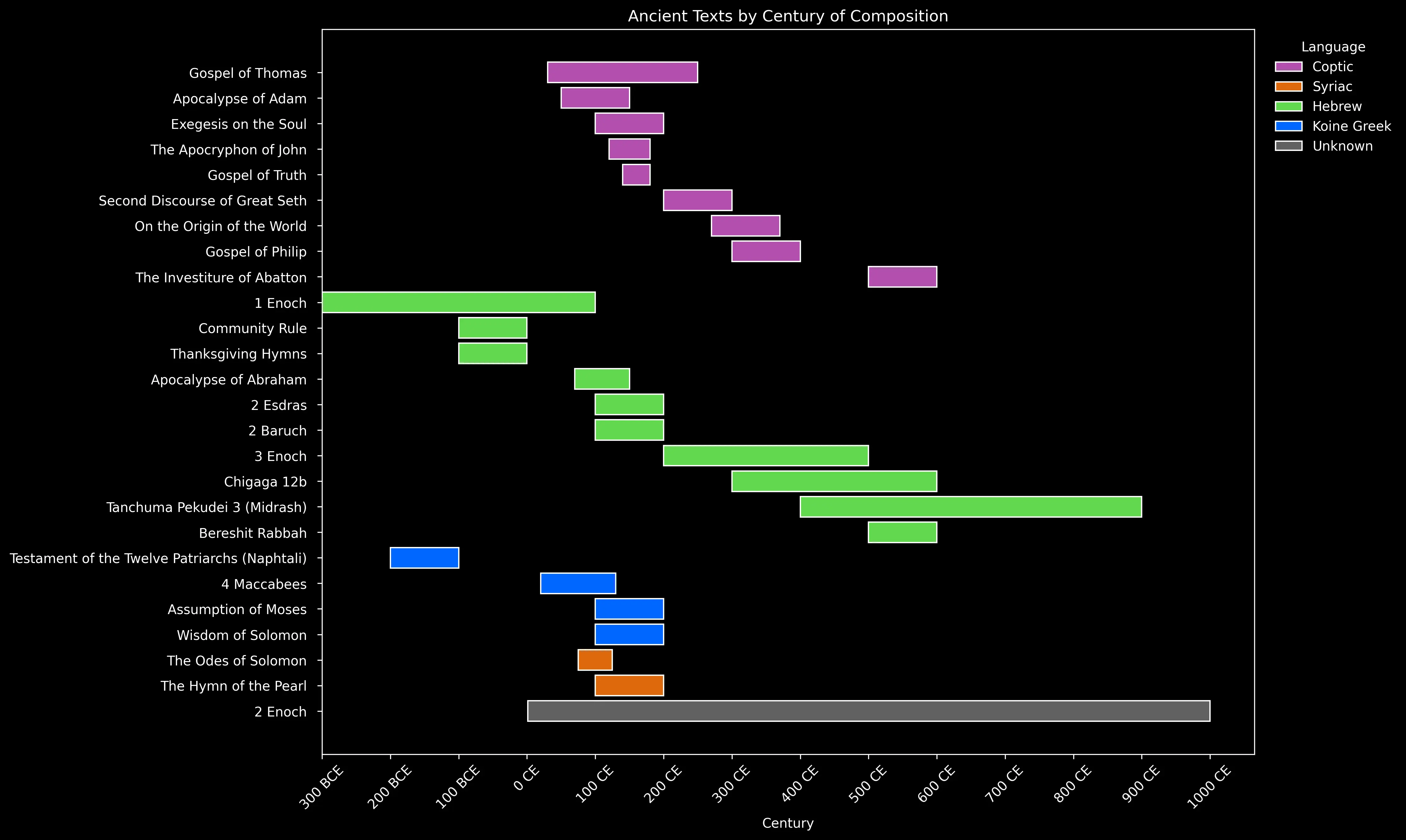
There are many sources between 200 BCE and 1000 CE that echo teachings of an actual premortal existence. Not only where some Jewish sects and various schools of Platonic philosophy teaching the idea, but it was a widely taught idea by early Christians as well. Below are a list of sources obtained from reading various articles that I would highly recommend reading. David Winston, Terryl Givens, Joseph Fielding McConkie, and Blake Ostler among others have written extensively about these sources. Below is a table with a graphic beneath showing the date ranges of these documents and how they are likely distributed through the centuries.
| Composition | Language | Date of Composition | Author | Manuscripts | Quotes |
|---|---|---|---|---|---|
| Community Rule | Hebrew | ~100 BCE | Unknown | 1QS 9:11—14 | "Before things came into existence he determined the plan of them" |
| Thanksgiving Psalms | Hebrew | ~100 BCE | Unknown | 1QH 3:19—23 | "By wisdom of thy knowledge thou didst establish their destiny before they came into existence" |
| Tanchuma Pekudei 3, Midrash | Hebrew | 400 — 900 CE | Unknown | Read the source here. | |
| Bereshit Rabbah | Hebrew | ~500 CE | Unknown | Read the source here. | |
| Chigaga 12b | Hebrew | 300 — 600 CE | Unknown | Read the source here. | |
| The Odes of Solomon | Syriac or Aramaic | 75 — 125 AD | Unknown, though possibly an Essene convert to Christianity | 23:2: “Grace is of the elect! and who shall receive it except those who trust in it from the beginning?” | |
| The Hymn of the Pearl | Syriac | 100 — 200 CE | Unknown | Acts of Thomas 108-113. Read the whole hymn. | |
| The Investiture of Abatton | Coptic | ~500 CE | Unknown, but purportedly by Timothy of Alexandria | Source link forthcoming. Currently unavailable. | |
| 2 Esdras | Hebrew or Aramaic4 | ~100 CE | Unknown, but likely an apocalyptic Jewish author | 4:3–6, 35–37: “Did not the souls of the righteous in their chambers ask about these matters, saying, ‘How long are we to remain here? And when will the harvest of our reward come?’ And the archangel Jeremiel answered and said, ‘When the number of those like yourselves is completed, for he has weighed the age in the balance, and measured the times by measure, and numbered the times by number, and he will not move or arouse them until that measure is fulfilled.’ ”” | |
| 2 Baruch | Aramaic or Hebrew5 | ~100-200 CE | Unknown | 23:4–5: "For when Adam sinned and death was decreed against those who were to be born, the multitude of those who would be born was numbered. And for that number a place was prepared where the living ones might live and where the dead might be preserved. No creature will live again unless the number that has been appointed is completed. For my breath creates the living, and the realm of death receives the dead." cf. 21:6 | |
| 4 Maccabees | Koine Greek | 20 — 130 CE | Unknown | 18:23: “But the sons of Abraham with their victorious mother are gathered together into the chorus of the fathers and have received pure and immortal souls from God,” | |
| Assumption of Moses | Hebrew, then Koine Greek | ~100 CE | Unknown | 1:12–15: "For He hath created the world on behalf of His people. But He was not pleased to manifest this purpose of creation from the foundation of the world, in order that the Gentiles might thereby be convicted, yea to their own humiliation might by (their) arguments convict one another. Accordingly He designed and devised me, and He prepared me before the foundation of the world, that I should be the mediator of His covenant." | |
| Wisdom of Solomon | Koine Greek | ~100 CE | Unknown, but likely an Alexandrian Jewish author | 8:19-20: "As a child I was naturally gifted / and a good soul fell to my lot / or rather, being good, I entered an undefiled body." | |
| Testament of the Twelve Patriarchs, Testament of Naphtali | Hebrew or Koine Greek | 200 — 100 BCE | Unknown | 4Q215 | 2:2—4: "For just as a potter knows the pot, how much it holds, and brings clay for it accordingly, so also the Lord forms the body in correspondence to the spirit, and instills the spirit corresponding to the power of the body. And from one to the other there is no discrepancy, not so much as a third of a hair, for all the creation of the Most High was according to height, measure, and standard. And just as the potter knows the use of each vessel and to what it is suited, so also the Lord knows the body to what extent it will persist in goodness, and when it will be dominated by evil." |
| 1 Enoch | Hebrew | 300 BCE — 100 CE | Unknown | 70:4: "And there I saw the first fathers and the righteous who from the beginning dwell in that place." | |
| 2 Enoch | Unknown6 | 1 — 1000 CE | Unknown | 23:5: "And when I had finished 30 days and 30 nights, Vrevoil said to me, “These things, whatever I have taught you, whatever you have learned, and whatever we have written down, you sit down and write – all the souls of men, whatever of them are not yet born, and their places, prepared for eternity. For all the souls are prepared for eternity, before the composition of the earth.” | |
| 3 Enoch | Hebrew | 200 — 500 CE | Unknown, though purportedly by Rabbi Ishmael | 43:1,3: “Come and I will show thee where are the spirits of the righteous that have been created and have returned, and the spirits of the righteous that have not yet been created. After that I went to interpret the following verse of Scripture and I found in what is written (Isa. 57:16): “for the spirit clothed itself before me, and the souls I have made” that (“for the spirit was clothed before me”) means the spirits that have been created in the chamber of creation of the righteous and that have returned before the Holy One, blessed be He; (and the words:) “and the souls I have made” refer to the spirits of the righteous that have not yet been created in the chamber” | |
| Apocalypse of Abraham | Old Slavonic | 70 — 150 CE | Unknown, though likely a Christian author | 22:1—5: “And I said: “Primeval One, Strong One, what is this picture of the creature?” And he said to me: “This is my will in relation to that which has a being in the Council, and it became pleasing before me, and then afterwards I commanded them to be through my word. And it came to pass that as many as I had authorized to exist, before portrayed in this picture, and had stood before me precreated,—as many as you have seen,” And I said: “Ruler, Strong One, Thou Who Wast Before the World, who are the multitude in this picture, on the right hand and on the left?” And He said to me: “These upon the left side are the multitude of former generations, and those to come after you. These for judgment and order; these for vengeance and destruction at the end of the world. But those on the right side of the picture are the people chosen for me, separate from the peoples of Azazel. These are those which I have prepared to be born through you and to be called my people." | |
| Gospel of Thomas | Coptic | 30 — 250 CE7 | Unknown | NHC II:2 | 49: “Jesus said, ‘Blessed are those who are alone and chosen, for you will find the kingdom. For you have come from it, and you will return there again.’”, 50: “Jesus said, ‘If they say to you, ‘Where have you come from?' say to them ‘We have come from the light, from the place where the light came into being by itself, established [itself], and appeared in their image’’’” cf. logia 18; 84: “Jesus said, ‘When you see your likeness, you are happy. But when you see your images that come into being before you and that neither die nor become visible, how much you will bear!’” |
| Gospel of Philip | Coptic | ~300 CE | Unknown | NHC II:3 | “When the light comes, one who can see will see the light, and the blind person will stay in darkness. The master said, ‘Blessed is one who is before coming into being. For whoever is, was and will be.’” |
| The Apocryphon of John | Coptic | 120 — 180 CE8 | Unknown, but likely from a Sethite Gnostic Christian | NHC II:1 & III:1 & IV:1 | [27] “This spirit lays a heaven burden on the soul, leads her into evil deeds, and hurl her down into forgetfulness. After the soul leaves the body, she is handed over to the authorities who have come into being through the archon. They bind her with chains and throw her into prison. They go around with her until she awakens from forgetfulness and acquires knowledge… This soul will be made to follow another soul in whom the spirit of life dwells, and she is saved through that one. Then she will not be trust into flesh again.” |
| On the Origin of the World | Coptic | 270 — 370 CE | Unknown, probably from an Alexandrian Gnostic | NHC II:5 & XIII:2 | “And when [Yaldaboath] knew for certain that an enlightened, immortal human existed before him, he was greatly disturbed, because earlier he had said to all the gods and their angels, ‘I am God; there is no other but me.’” |
| Gospel of Truth | Coptic | 140 — 180 CE | Unknown, probably from a Valentinian Gnostic | NHC I:3 & XII:2 | “The forgetfulness of Error was not apparent. It is not … from the Father. Forgetfulness did not come into being from the Father, but if it did come into being, it is because of him. What comes into being withing him is knowledge, which appeared so that forgetfulness might be destroyed and the Father might be known. Forgetfulness came into being because the Father was not known, so as soon as the Father comes to be known, forgetfulness will cease to be.” “They will hasten to return receive from that place, the place where they stood once before, and they will taste of that place, be nourished, and grow.” |
| Exegesis on the Soul | Coptic | 100 — 200 CE | Unknown | NHC II:6 | “While the soul was alone with the Father, she was a virgin and androgynous in form. When she fell down into a body and entered this life, she fell into the hands of many robbers… My Father, save me. Look, I shall tell [you how I] left home and fled from my maiden's quarters. Restore me to yourself… For many afflictions have come upon her because she left home.” |
| Apocalypse of Adam | Coptic | 50 — 150 CE | Unknown | NHC V:5 | “After God created me out of earth, along with your mother Eve, I went about with her in a glory that she had beheld in the eternal realm we had come from… for we were superior to the god who had created us and the powers with him, whom we did not know.” |
| Second Discourse of Great Seth | Coptic | ~200 CE | Unknown | NHC VII:2 | “The soul from on high will not discuss error here or carry herself away from these realms that are here.” |
Below is a graphic showing the timeline distribution of these sources:
Tacit References to Premortality in the Book of Mormon
The Book of Mormon has even clearer references to human premortality than any biblical passage. In one particular history, Alma's son Corianton commits a grave sexual sin during their mission to the Zoramites. In chapter 39, Alma takes the opportunity to rebuke Corianton. Dovetailing his initial statement, Alma continues to discusses justice and mercy and its relation to the resurrection.
Alma describes a time that an angel told him about what occurs between death and the resurrection:
Now, concerning the state of the soul between death and the resurrection—Behold, it has been made known unto me by an angel, that the spirits of all men, as soon as they are departed from this mortal body, yea, the spirits of all men, whether they be good or evil, are taken home to that God who gave them life.
— Alma 40:11
The wording of this passage seems to be influenced by that of Ecclesiastes 12:7. It mentions the mortal body and the spirit, or rūaḥ, that returns to God who gave it. He then continues to describe how justice and mercy are preserved because of the Atonement of Christ. Alma also ties this concept in with the resurrection and the law of the harvest. He explains that the Atonement restores humanity to God's presence. Using a rhetorical gradation9, Alma presents his teaching as follows:
...
cease to be God. But God
ceaseth not to be God, and
mercy claimeth the penitent, and
mercy cometh because of the
atonement; and the
atonement bringeth to pass the
resurrection of the dead; and the
resurrection of the dead bringeth back men into the
presence of God; and thus they are restored into his
presence, to be judged according to their works,
according to the law and justice.— Alma 42:22-23
The implication here is that humanity was once in the presence of the Lord in some way. After the resurrection, according to Alma, mankind would be "restored into his presence to be judged according to their works". This idea is echoed by other figures in the book. Samuel the Lamanite gave a prophetic lawsuit against the Nephites where he employs the same wording as Alma10; likewise with Moroni's invitation to his readers to repent11. Further, the prophet Jacob gives a woe oracle where he mentions those who die in their sins as they will "return to God, and behold his face, and remain in their sins"12.
In the Book of Ether, there is an episode where the premortal Jesus Christ appears to the Brother of Jared. What Patrick fails to mention is that the wording used by Jesus is subtle:
And when he had said these words, behold, the Lord showed himself unto him, and said: Because thou knowest these things ye are redeemed from the fall; therefore ye are brought back into my presence; therefore I show myself unto you.
— Ether 3:13
The words of Jesus to the brother of Jared indicate a stronger notion than mere ideal premortality.
Premortality as the background assumption of the Garden narrative
One intriguing detail to note is that every mention of humanity's returning to God in the Book of Mormon is connected to the story of Adam and Eve in the Ancestral tradition. The prophet Jacob's woe oracle is preceded by a statement about Adam being cut him off from the presence of Adonai due to the Fall13. Alma's discussion with Corianton discusses the Fall of mankind following the revelation of the spirit world a few chapters later14. Samuel the Lamanite tells the Nephites that the resurrection brings mankind back to Adonai's presence, thus reversing the Fall of Adam15. The brother of Jared is told by Jesus, as seen above, that he had been redeemed from the Fall. After mentioning the Fall of Adam, Moroni states the resurrection brings mankind back to God's presence16.
From this data, it appears that a particular trajectory materializes. If Adam and Eve represent humanity in a mystery cultic sense, then the implication is that humanity once dwelt in the presence of God before entering mortality. It is also worth noting that in the Garden story, Adam's spirit was breathed into him from God; there is no story of its creation but rather its placement. Thus, Adam's rūaḥ (spirit/breath) existed prior to it being inserted into his body by God. Further adding to this is the idea in Latter-day Saint tradition that Adam was the archangel Michael who helped Adonai organize the world in the endowment ceremony, following the Garden narrative.
Notice how I haven't even touched on Alma 13 yet. As I read it, the entire chapter drips with priestly language and concepts. It ostensibly reflects a similar understanding to Jeremiah 1:5. One intriguing thing to note is the placement of this chapter in context to Alma and Amulek's discussion with the citizens of Ammonihah. Antionah, a chief ruler, questions Alma soon after Zeezrom is silenced, and his question has to do with the Garden of Eden (Alma 12:20-37). In summary, Antionah wonders how the resurrection could come about if Adam and Eve (who represent humanity) were prevented by cheribim to enter back into the Garden and partake of the tree of life. Alma responds by suggesting that the Fall had to occur in order to prepare mankind to meet God, and so that they could be judged. (In another sense, one could say that the only way to reap the fruit of the tree of life is to have an experience with life.) The way one returns to back into the presence of God and partake of the tree of life is by repenting and following the Son of God. Succeeding this idea, Alma 13 takes the stage.
This will be expanded in a forthcoming update.
Pearl of Great Price
Perhaps the most explicit reference to premortal existence of a person in Latter-day Saint canonical scriptures is in the Book of Abraham:
Now the Lord had shown unto me, Abraham, the intelligences that were organized before the world was; and among all these there were many of the noble and great ones; And God saw these souls that they were good, and he stood in the midst of them, and he said: These I will make my rulers; for he stood among those that were spirits, and he saw that they were good; and he said unto me: Abraham, thou art one of them; thou wast chosen before thou wast born.
— Abraham 3:22-23
Abraham was an intelligence who was organized before God made the world. Following my translation of Jeremiah, it appears, Abraham is told that he was chosen to be a ruler before he was born.
Conclusion
In closing, the criticism that the actual premortal existence of man is not found in ancient texts misses the core of the Latter-day Saint position. To Latter-day Saints, God reveals His truths through living prophets, who have authority to expand upon or correct previous understandings. Revelation — not textual consistency with ancient scripture — is the ultimate source of doctrine to Latter-day Saints.
Link is here: https://uncorrelatedmormonism.com/is-pre-existence-real/
For an excellent discussion of the relevance of Jeremiah 1:5 in Latter-day Saint hermenutics, see "Formed in and Called from the Womb" by Dana M. Pike. See also "On Preexistence in the Bible" by Kevin L. Barney. I differ with Pike and Barney on a couple of points. While I agree with Pike that the last two components of Adonai's tripartite statement could be interpreted apart from the first, I concur with Barney contra Pike that the most natural reading of the passage implies prenatal ordination. I remain unconvinced, however, by Barney's claim that the ideal and actual premortal interpretations are equally probable. I am not aware of any examples of prophetic ordination performed for absent (let alone ideal) recipients in any Israelite sources, a point that neither Barney nor Pike address.
The only extant languages that exist for this text are in Latin. It is hypothesized they were written in Hebrew or Aramaic due to the content of the narrative, then to Greek (ch. 1-2 and 15-16 are considered Christian additions) and then into Latin.
The oldest manuscripts for this work are found in Syriac.
Slavonic and Coptic manuscripts exist. Scholars believe this work has multiple layers of traditions with some going back to prior to the Roman siege of Jerusalem to the Medieval period.
It is believed by many scholars that some of the teachings do go back to Jesus himself, while other portions are probably later interpolations. Hippolytus of Rome and Origen of Alexandria cite from it in 222 — 235 CE so we know the work is at least that old.
The text from this book was cited by Irenaeus around 180 CE in his writing Against Heresies 1.20.1.
See "Poetic Parallelisms in the Book of Mormon" by Donald Parry, pg. 335; download from Scholar's Archive website from BYU: https://scholarsarchive.byu.edu/mi/61/